The Leading Framework for PCI SSF Compliance Pakistan & Secure Software Framework Pakistan
As Pakistan’s software exports surge across the fintech, digital banking, and payment gateway sectors, securing applications against modern threat vectors is no longer optional. PCI SSF Compliance Pakistan standards represent the definitive gold standard for secure application design and engineering. Replacing the legacy PA-DSS, the PCI Software Security Framework (SSF) ensures that payment software is designed, developed, and maintained to withstand the most sophisticated cyber threats.
Headquartered in the tech-hub of Karachi, CW provides a risk-based methodology that aligns your Secure SDLC with both the State Bank of Pakistan (SBP) digital security requirements and global PCI standards.
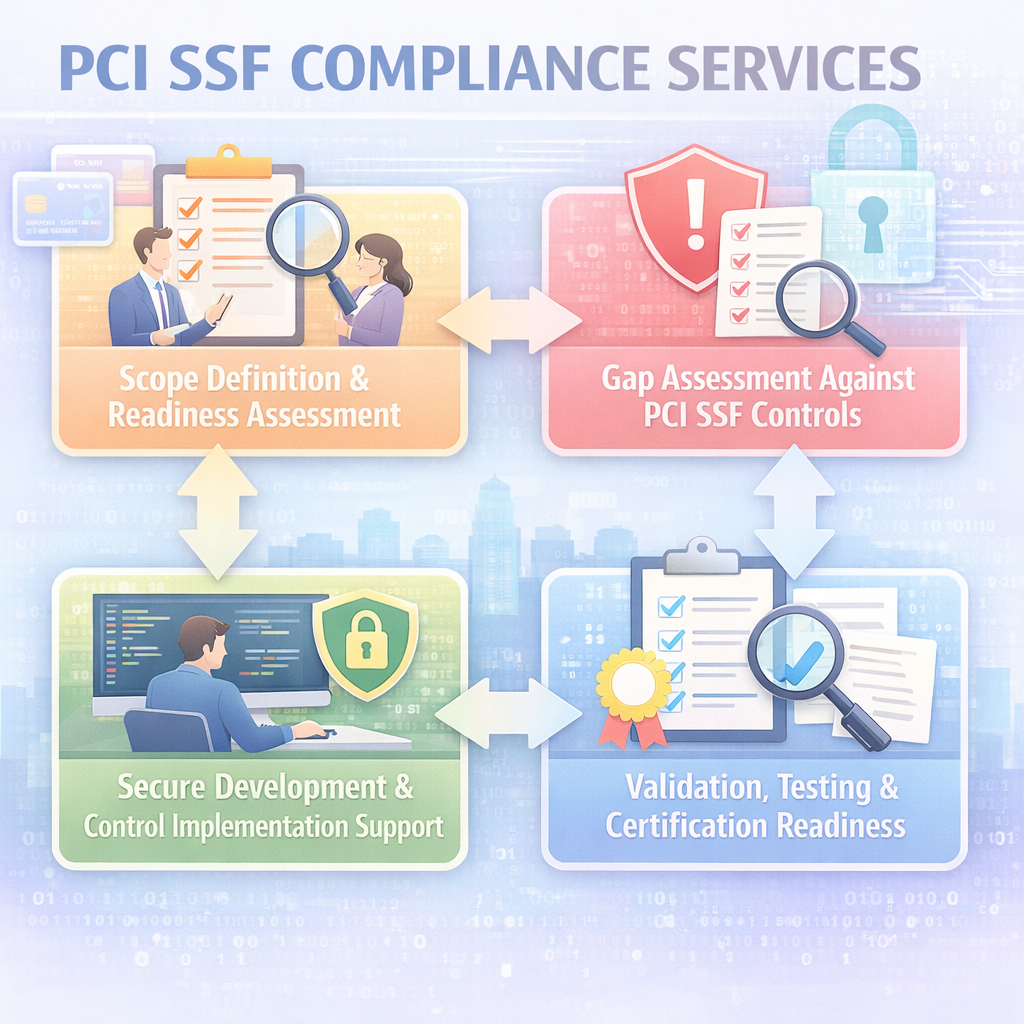
SSF Scoping & Readiness Assessment
Gap Assessment Against PCI SSF Controls
Secure Development & Control Implementation Support
Ensuring efficient, clear, and fully aligned security design, development, testing, and maintenance to protect sensitive cardholder data.
1.SSF Scoping & Readiness Assessment
We begin by understanding your payment software architecture, development lifecycle (SDLC), and hosting environment. This phase identifies in-scope applications, components, and data flows to determine compliance requirements under PCI SSF (Secure Software Standard & Secure SLC Standard).
Key Outcomes: 1. Architecture Validation: We audit your data flows and hosting environments (local or cloud). 2. Karachi Dev-Team Integration: We work directly with your software teams through on-site collaboration in Karachi to map out components and dependencies. 3. Risk Overview: Identifying the “compliance applicability” to ensure you aren’t over-engineering your security.
2. Gap Assessment Against PCI SSF Controls
We assess your secure development practices, technical controls, and governance processes against PCI SSF requirements. This includes evaluating secure coding standards, authentication mechanisms, encryption practices, vulnerability management, and change control procedures.
Key Outcomes: 1. Secure Coding Standards: Evaluating your code against global standards to identify vulnerabilities. 2. Control Weakness Mapping: We analyze your authentication mechanisms and encryption practices. 3. SBP & Regional Alignment: Ensuring your gap report highlights requirements needed for the Pakistan and Qatar financial markets.
3.Secure Development & Control Implementation Support
CW provides expert guidance to strengthen secure software design and development practices. We assist in implementing required controls, enhancing SDLC security, integrating DevSecOps practices, and improving monitoring capabilities.
Key Outcomes: 1. DevSecOps Integration: Automating security within your pipeline to reduce human error. 2. Technical Hardening: Enhancing monitoring and vulnerability management processes. 3. Policy Kits for Software Houses: Pre-built templates for secure software design that satisfy PCI SSF Pakistan auditors.
4. : Validation & Certification Readiness
We conduct independent validation activities including secure code review, vulnerability assessment, and control effectiveness testing to ensure alignment with PCI SSF requirements. This final phase prepares your application for formal assessment. We conduct independent validation to ensure your software is ironclad.
Key Outcomes: 1. Secure Code Review: A manual and automated look at your source code to verify control effectiveness. 2. Certification Support: We provide the documentation and evidence needed for a smooth sign-off by a QSA. 3. Middle East Readiness: Ensuring your software meets the data residency and security protocols required for expansion into Qatar and the UAE.
Core Components of Our Audit Process
To provide the best Cybersecurity Health Check, we dive deep into these critical technical areas:
Application Architecture & Configuration
We evaluate the fundamental design of your software for better security. Our Cyber Security Audit in Pakistan identifies insecure configurations within the code and environment that create unnecessary weaknesses. By hardening these areas, the Cybersecurity Health Check prevents attackers from finding easy entry points.
Secure SDLC Plan
Essential for Fintech software houses in Karachi scaling globally while maintaining SBP digital security alignment.
Validation Report
Technical proof of security for your clients in the Middle East, verifying your adherence to the Secure Software Framework Pakistan.
Roadmap to RoC
The final strategic step toward achieving full PCI SSF certification and meeting all SBP regulatory mandates
Frequently Asked Questions
PCI SSF FAQs
1. What is the difference between PA-DSS and PCI SSF Compliance Pakistan?
PCI SSF completely replaces the legacy PA-DSS standard. While PA-DSS focused strictly on commercial payment applications, achieving **PCI SSF Compliance Pakistan** standards requires a holistic approach built around a continuous Secure SDLC, rigorous data isolation, and a comprehensive Sensitive Assets Model that aligns with modern, cloud-native engineering.
2. Does the State Bank of Pakistan mandate the Secure Software Framework Pakistan?
Yes, the SBP heavily regulates digital banking infrastructure, fintech entities, and Electronic Money Institutions (EMIs). Any software house building applications that handle, process, or transmit transactional card data must align their development cycles with the **Secure Software Framework Pakistan** to successfully pass central bank security audits and secure operational licensing.
3. What are the mandatory source code review rules in the PCI SSF v2.0 update?
Under the updated v2.0 parameters, code sampling is no longer allowed during formal assessments—100% full source code visibility is completely mandatory. Software engineering teams must subject their entire codebase to rigorous Static and Dynamic Application Security Testing (SAST/DAST) to prove control effectiveness before a Qualified Security Assessor (QSA) can grant validation.
4. How often do software houses in Karachi need to re-validate their SSF status?
An Attestation of Validation (AOV) under the Secure Software Framework is required annually. However, if your development team implements significant architectural adjustments or structural updates to the application code throughout the year, you must conduct intermediate change-impact assessments to ensure continuous compliance.
5. How does Compliance Wing cut down on total software architecture engineering costs?
Our specialized consultants work face-to-face with your engineering teams to implement precise boundary controls and data segmentation. By cleanly isolating your cardholder environments, we dramatically reduce your overall audit surface area—saving local software houses up to 40% in unnecessary infrastructure over-engineering and compliance tracking costs.
Why Software Houses in Karachi Choose CW
In a market saturated with generic IT consultants, CW stands out as the expert for Secure Software Framework Pakistan mandates. Our proximity to the Karachi Fintech hub and deep understanding of SBP circulars allows us to offer on-site code reviews and face-to-step consultation that global firms simply can’t match. Build secure software. Win global trust.