PCI DSS Compliance in Pakistan: The Local Financial Standard
The digital payments landscape in Pakistan is under strict transformation. With the State Bank of Pakistan (SBP) mandate for enhanced cybersecurity, PCI DSS Compliance in Pakistan is the essential credential for any organization handling cardholder data. Whether you are an EMI or a retail bank, meeting the v4.0.1 global standard is critical for operational licensing and consumer trust.
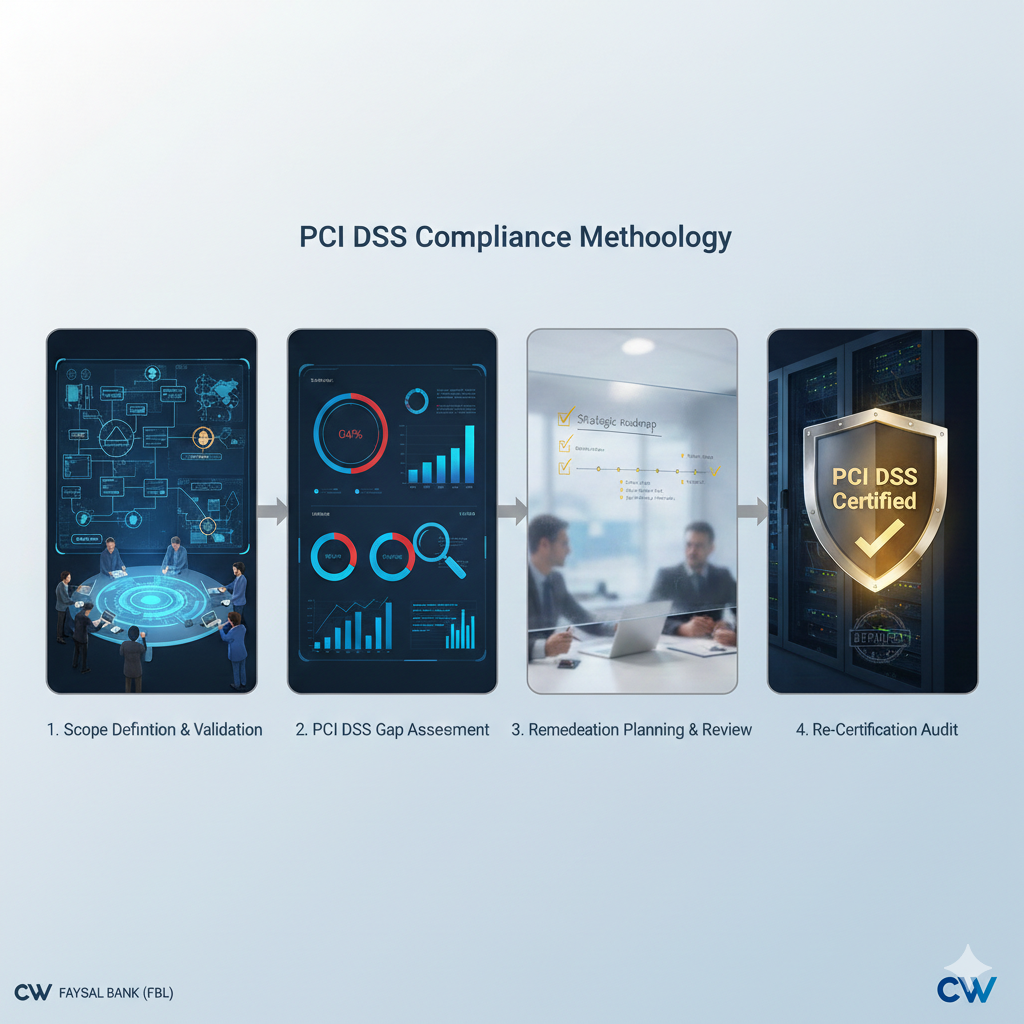
From our core operations in Karachi, CW delivers a specialized methodology that bridges the gap between local SBP regulations and international security standards, ensuring your business is ready for both the local and Middle Eastern markets. CW adopts a structured, phased approach to support throughout the complete PCI DSS compliance lifecycle, ensuring efficiency, clarity, and regulatory alignment.
Strategic Scoping & SBP Regulatory Mapping
PCI DSS v4.0.1 Gap Assessment
Remediation & Security Engineering
Final Certification & Audit Defense
Our Structured PCI DSS Compliance Approach
Ensuring efficient, clear, and fully aligned compliance across the entire PCI DSS lifecycle
1. Strategic Scoping & SBP Regulatory Mapping
The foundation of a successful PCI DSS audit in Pakistan is a precise scope. Many Pakistani firms over-audit their systems, leading to unnecessary costs. We help you trim the fat.
1. CDE Optimization: We identify and isolate your Cardholder Data Environment. 2. Karachi Financial Hub Expertise: For firms headquartered in Karachi, we offer on-site infrastructure mapping to ensure your local data centers are optimized for SBP inspections. 3. Regulatory Mapping: We align your scope with SBP PSD circulars to ensure 100% domestic compliance.
2. PCI DSS v4.0.1 Gap Assessment
Our gap assessment is the most vital step for PCI DSS Compliance in Pakistan. We perform a rigorous “health check” of your security controls.
1. Vulnerability Detection: We find the security gaps in your network before an official auditor does. 2. Customized Roadmap: You receive a detailed report tailored to the Pakistani tech stack—addressing everything from local hosting challenges to hybrid cloud configurations. 3. Compliance Scorecard: A clear view of your readiness for certification in Pakistan
3. Remediation & Security Engineering
Closing the gaps requires more than just advice; it requires execution. We provide the technical and procedural support necessary to meet PCI DSS requirements.
1. Document Frameworks: We provide policy and procedure templates that meet SBP “Cyber Shield” standards. 2. Technical Hardening: Guidance on implementing Multi-Factor Authentication (MFA), end-to-end encryption, automated vulnerability management, and secure logging tailored to Pakistan’s infrastructure 3. Training: Security awareness programs for your staff in Karachi and beyond, fostering a culture of compliance.
4. Final Certification & Audit Defense
The final phase is your official validation. We ensure that your PCI DSS Certification in Pakistan is recognized globally and locally by the SBP.
1. RoC & SAQ Support: We assist with the “Report on Compliance” for Level 1 entities and SAQs for smaller merchants. 2. Audit Representation: We act as your technical shield during the final audit, ensuring your controls are presented accurately to the certified PCI DSS QSA in Pakistan. 3. Ongoing Compliance: We manage your quarterly ASV scans and annual penetration tests, keeping you compliant year-round in the Pakistan and Middle East regions.
Why Choose CW for PCI DSS in Pakistan?
SBP Expertise
Our frameworks are built specifically for Pakistani regulatory circulars.
Karachi Hub Focus
Deep experience with Karachi’s banking and fintech infrastructure.
Cost Effective
Our advanced scope strategies reduce and save Pakistani firms up to 40% in audit costs.
Middle East Bridge
One certification that opens doors in Qatar, UAE, and Saudi Arabia.
Frequently Asked Questions
PCI DSS FAQs
1. What is PCI DSS and who needs it in Pakistan?
PCI DSS is a global security standard required for any organization that stores, processes, or transmits cardholder data. In Pakistan, this explicitly applies to commercial banks, microfinance institutions, payment gateways, and Electronic Money Institutions (EMIs) handling debit or credit card transactions.
2. Who regulates PCI DSS compliance in Pakistan?
While governed globally by the PCI Security Standards Council, compliance is strictly mandated and enforced at the state level by the State Bank of Pakistan (SBP) through targeted PSD circulars and cybersecurity frameworks. Passing an audit is an essential credential for securing and maintaining your operational licensing.
3. What is the difference between ISO 27001, SOC 2, and PCI DSS?
ISO 27001 is a broad framework managing an overall information security management system (ISMS), and SOC 2 focuses on general internal privacy and cloud data controls. In contrast, PCI DSS is an absolute, mandatory technical standard strictly governing environments that handle sensitive payment card infrastructure.
4. How much does it cost to get PCI DSS Certification in Pakistan?
The total cost of a PCI DSS certification varies depending on your transaction volume (PCI Level) and network complexity. Compliance Wing specializes in advanced data segmentation and Cardholder Data Environment (CDE) scoping optimization, which helps local firms cut down their total architectural and infrastructure compliance overhead by up to 40%.
5. Does Compliance Wing provide end-to-end support for a PCI DSS QSA in Pakistan?
Yes, we provide comprehensive, lifecycle support. We manage everything from strategic scoping and deep v4.0.1 gap assessments to technical security engineering, remediation, and final audit defense representation alongside a certified PCI DSS QSA in Pakistan.
6. Can you help with PCI DSS remediation and security hardening?
Absolutely. Our specialized consultants work hands-on with your technical and software engineering teams to remediate gaps efficiently. We assist with building compliant document frameworks, configuring robust firewalls, and implementing strict logical access controls and Multi-Factor Authentication (MFA).
7. Do you provide ASV scanning and penetration testing for PCI DSS?
Yes, we handle your required quarterly Approved Scanning Vendor (ASV) scans and annual internal/external penetration testing, ensuring your technical infrastructure maintains a continuous, year-round compliant posture to satisfy central bank inspections.
8. Can you support complex, hybrid, or multi-location PCI environments?
Yes. From our main operational hub in Karachi, our team possesses extensive experience mapping out localized data infrastructures, multi-branch banking networks, and hybrid cloud configurations to optimize your systems for local and Middle Eastern regulatory markets.
Secure Your SBP License Today
Don’t let compliance hurdles slow your growth. Join the elite group of Pakistani fintechs that have secured their future with CW.